

Maria Polyzou — The Woman Who’s Still Running… but This Time Inward

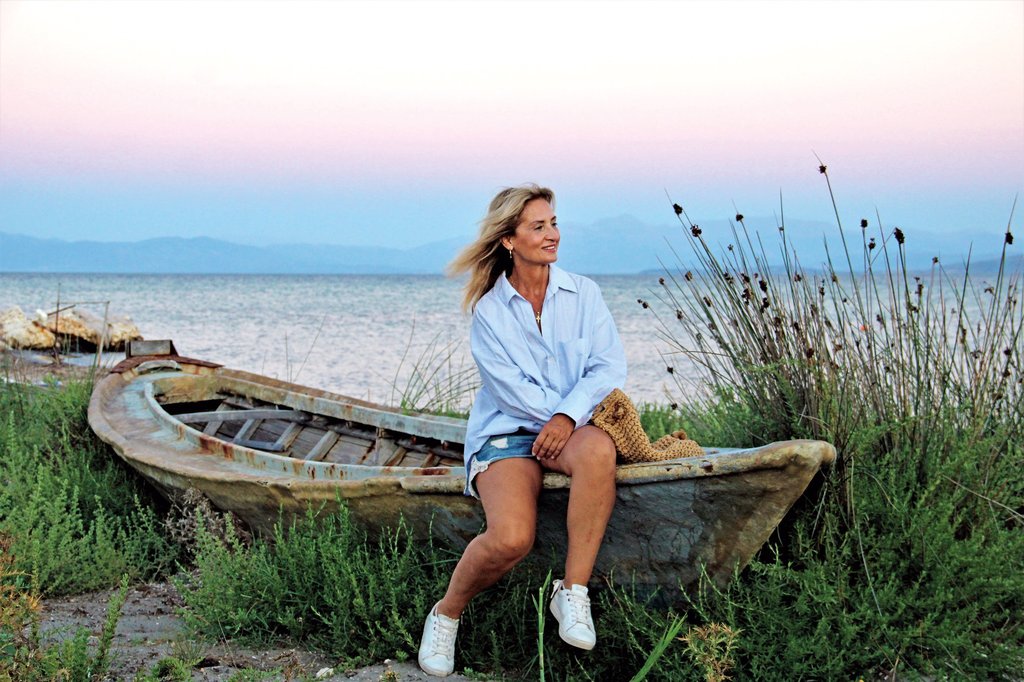
Some people run to outrun time. Others run to understand it. Maria Polyzou belongs to the second kind. Champion, coach, author, and a symbol of spiritual endurance, she was the first Greek woman to compete in the Olympic Marathon at the 1996 Atlanta Games—and the first to look inward with the same determination she once reserved for the finish line.
Today, Maria no longer counts just kilometers, but moments. She doesn’t chase records anymore, but truths. In the conversation that follows, she reveals the woman behind the athlete: a mother who rediscovered herself through her daughter, a partner who believes in the freedom of being together, and a soul who insists on finding light in simplicity and living by the words “Never Give Up”—not as a slogan, but as a philosophy.

Who were your role models as a woman? What images shaped you?
When I was growing up, there was no internet, no social media. Television didn’t have the reach it does today. I had no access to female role models, no big-name athletes or public figures to inspire me. The first time I ever watched the Olympics was in 1984 in Los Angeles, when Joan Benoit won the first-ever Olympic women’s marathon. That image shook me to my core. That was the moment I thought, “This can happen.” As I grew older, I admired women who didn’t put the “I” above the “we.” Mother Teresa was one such figure for me—she dedicated her entire life to others. In Greece, Marianna Vardinoyannis is a woman who has changed the lives of thousands of children. When I started running, no Greek woman had ever competed in the Olympic marathon. I had to open that path myself—and that’s never easy. Because being the first means carrying the weight of keeping the trail open for those who come after you.

How do you experience motherhood today? How has it changed your relationship with yourself?
You don’t become a mother only by giving birth. You become a mother the moment you feel that life growing inside you. That’s when the journey of care, anxiety, and devotion begins. When my daughter Agapi came into my life, I felt the urge to become the best version of myself—for her. Through Agapi, I rediscovered who I was. I grew up in a tough environment, without the love of my parents. I didn’t know what care, affection, or safety really meant. Agapi taught me what normality is. What it means to raise a child in peace, acceptance, and love. Through that journey, I became softer, more whole. Because by taking care of her, I learned to care for myself too. Motherhood gave me a new lens on life. I’m not just a runner, a coach, or a public figure. I am, first and foremost, Agapi’s mom.

How do you define companionship? What does “togetherness” mean to you, in a way that endures over time?
For me, companionship means freedom. It means allowing the other person to grow, to change, to evolve—and accepting them exactly as they are. And that has to go both ways. Togetherness, to me, means respecting the other’s needs. Not punishing them for changing. Meeting them again on their new path and asking honestly, “Do we still want to walk this journey together?” Companionship is not a prison. It’s love, respect, freedom, and truth. The truth of the moment.
What are the moments that bring you genuine happiness?
For me, happiness is very simple. It’s freedom. It’s when I drive off with my camper van, with my little dog Sissi by my side, and disappear into the mountains or by the sea. I spend countless hours in that van. It’s my sanctuary—the place where I create, where I escape the pressures and the “musts.” I love lying on the sand, staring at the stars, feeling the moonlight shine on my thoughts. I feel God speaking to me through the silence. My favorite place in the world is a stretch of land in Aetoloakarnania, in a spot called Tholi, in a village called Niochori. A barren islet, with no one around. Just me, nature, and God. That’s where I recharge. That’s where I find myself again.

What troubles you most about modern Greece, and what would you do to change it?
What pains me is that we live in a society that has lost its sense of “us.” Everyone is looking out for their own interests, doing whatever they want, wherever they want, without thinking of those around them.
It saddens me that we don’t respect public space, the environment, animals. That we don’t care about our neighborhoods or the people next door. We’ve made great strides in technology, but we’ve forgotten to evolve as human beings. The Greece of philosophy has forgotten how to philosophize life. What would I do to change it? I’d start small. From the neighborhood, from action. Let’s talk to each other again. Let’s do something for others without expecting anything in return. The world only changes when we change first.

Why did you write “Never Give Up”?
Never Give Up is not just the story of my life. It’s a life guide—for anyone fighting their own battle. For anyone who falls and needs to get back up. For children who dream.
For young people beginning their journey. For those facing illness, hardship, or their own uphill climbs.
Everyone can find a piece of themselves in this book. Because when you follow your own path, when you stay true to your values and don’t water them down, you arrive—not just at personal achievement, but at personal happiness.

What message would you like to share with young women starting their journey in life?
Endurance. Emotional endurance. Respect yourselves, honor your values, keep your dreams alive. Don’t give up. You’ll need patience, daily effort, and a kind of life training to get where you want to go.But above all—love what you do. Only then will you reach the top.
Thank you very much!