
Anastasia Zannis (Soprano): “Success lives in the here and now”

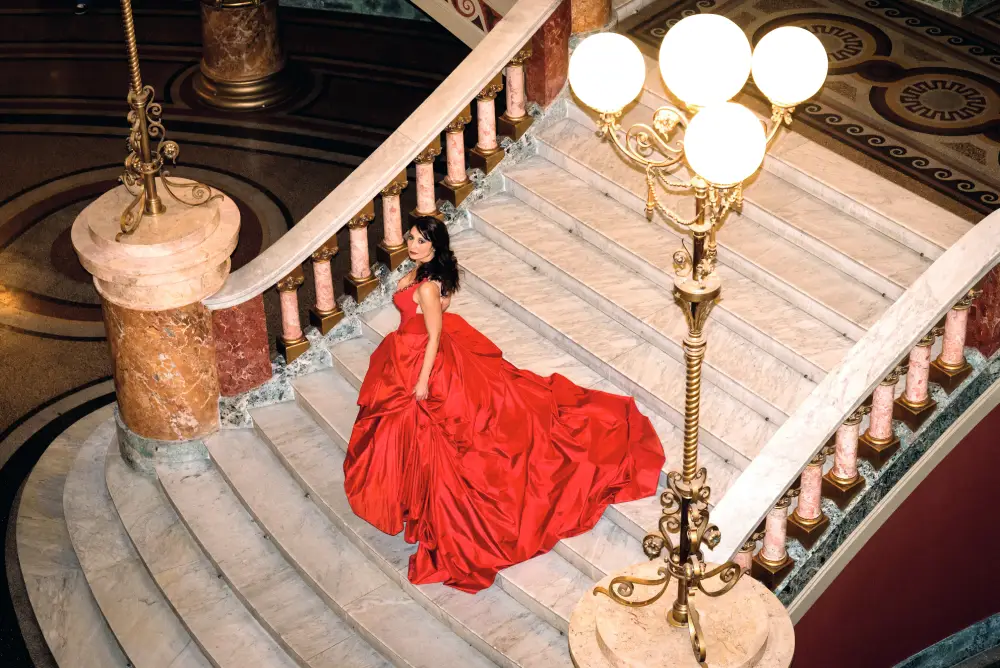
Soprano Anastasia Zannis speaks about her journey from classical to contemporary music, her decision to remain an independent artist, and the experiences that shaped her in Greece and abroad. With honesty and sensitivity, she unfolds her thoughts on music, loss, perseverance, and the meaning of success.
Photography: Marina Vernicos
If you had to describe yourself beyond the title “soprano,” what would you say?
Independent — and a true lover of music. “Spinto soprano” is my vocal type. Along the way, however, I moved toward a more modern direction, embracing contemporary repertoire as an independent artist — meaning without being represented by restrictive contracts. That is part of my independence. In New York, a whole new world opened up to me through the concept of “independent artists,” which was very common there. In Greece, you had to belong somewhere in order to exist professionally. So I chose to function independently, both as an artist and as a person. That alone guided me in the right direction, bringing me beautiful, unexpected, and important artistic opportunities — moments I am very proud of.
What is the first musical memory that truly shaped you?
When I sang at the opening ceremony of the Winter Olympic Games in Calgary, Canada. I was very young when I represented Greece, after a competition, alongside children from all over the world. Our first meeting, I remember, was in Paris. Then we went to the United States, where we met conductor and composer David Foster, who had written the songs. After that, we traveled to Canada and performed in honor of King Charles and Princess Diana, shortly before the Olympic opening ceremony. It felt like a fairytale experience at the time.

How did your family influence your relationship with music?
My family was supportive and played a defining role. There was a Steinway piano in our home, from my grandfather, which I loved — at first almost like a toy. My father adored music and would bring me records to listen to. I grew up in a family that truly loved music.
You studied classical singing as well as jazz. How do these two coexist within you?
Through emotion. I feel both genres very deeply; I am naturally drawn to them. They also remind me of my childhood — when I used to step into the wardrobe and pretend I was in the studio with Barbara Streisand. It was funny. But in a way, I always return to those musical memories.
Was there ever a moment when you felt you didn’t fully belong to any one musical genre?
Constantly. Because I always feel like a student, as though there is always something more to achieve before I can truly say I belong to or represent a specific genre.

Which artists have shaped the way you interpret music today?
I have admired many performers across different genres. Maria Callas was beloved by my family and by my first teacher, Kiki Morfoniou, who had sung with her — so she became an influence and artistic reference for me as well. Later on, I fell in love with Ella Fitzgerald, Nina Simone, Barbra Streisand, Nat King Cole, Louis Armstrong, Perry Como, and Tony Bennett, whom I had the privilege of meeting and speaking with about my work in New York.

Was there a turning point in your career that changed how you see yourself?
There comes a moment when you mature and your perspective shifts. Mine was when I lost my father… I became more serious and began searching for him in the things he loved most. That is when I left for New York. There, I saw myself gradually change — becoming more dynamic, more assertive — perhaps subconsciously to make him proud, or to reassure my mother and my brother, since I am the eldest, that everything would be alright and that we should not fear the difficulties we were facing at the time.

What did it mean to you to perform the National Anthem at the Acropolis?
I feel deeply proud as a Greek. It was the culmination of everything that came before. I sang on a historic day for my country —the Bicentennial of Greek Independence— in front of the Parthenon, in the presence of the Presidential Guard, broadcast live internationally. I feel grateful; it was a blessing. I had actually submitted it as a proposal to all the institutions, as an independent artist. They didn’t approach me — I proposed it, with love and respect for the Greek diaspora, having already had the experience of performing the National Anthem while opening, emotionally, the parade on Fifth Avenue in New York.

What does your relationship with the Greek diaspora mean to you?
The Greek diaspora embraced me and gave me a sense of belonging. I thank them from the bottom of my heart. My concert at Carnegie Hall was a lifelong dream come true. They believed in me. I met wonderful families, made friends, and became part of the community. Homeland, there, feels like homeland twice over.

Have you ever felt that you had to prove more than what should be expected?
By performing and traveling internationally after America, I was exposed to global audiences — and that was another important milestone and success for me. From Japan and Seoul, where I performed twice, to Rome, Egypt at the Cairo Opera House, Monte Carlo in honor of Prince Albert, and the Olympic Games. When I returned to Greece as an independent artist, I had to communicate all of this with greater effort, because there was surprise — and sometimes skepticism: “But how did you do it?”
How do you recharge when you’re not singing?
In many ways. I often walk aimlessly and observe people. I also turn to sports, as a former tennis player. I go to a place I love — a traditional café — where the regulars are old friends of my father. I feel safe there. They call out, “Come on, soprano, tell us your news!” and we laugh. Wherever I go, I create a place of belonging — even in New York. It’s a Greek habit I cherish: different people connecting, and witnessing an authentic slice of society.
What is your next artistic step?
I plan to focus more on the music and songs I have created over time. It’s material I always kept to myself, but now I’m thinking of daring to share it. Bringing everything into the light.
If your life were an aria, which one would it be?
What a beautiful question! I think it would be “Habanera” from Carmen by Bizet. It speaks of a way of life — artistic, emotional, and spontaneous. I would also call it authentic.

Ultimately, what does success mean to you?
For me, success is the here and now. I believe we are defined by place and time. Success is a challenge — not a permanent state. It is every decision you are called to make in the present moment. The question you ask yourself: “Did I make the right choice?” — and then you begin again. You immediately move on to the next chapter or “snapshot” of your life, whether big or small, always centered in the present. That is success.
Thank you so much!