
Posidonia 2026: Greek Shipowners Signal Confidence Amid Industry Headwinds

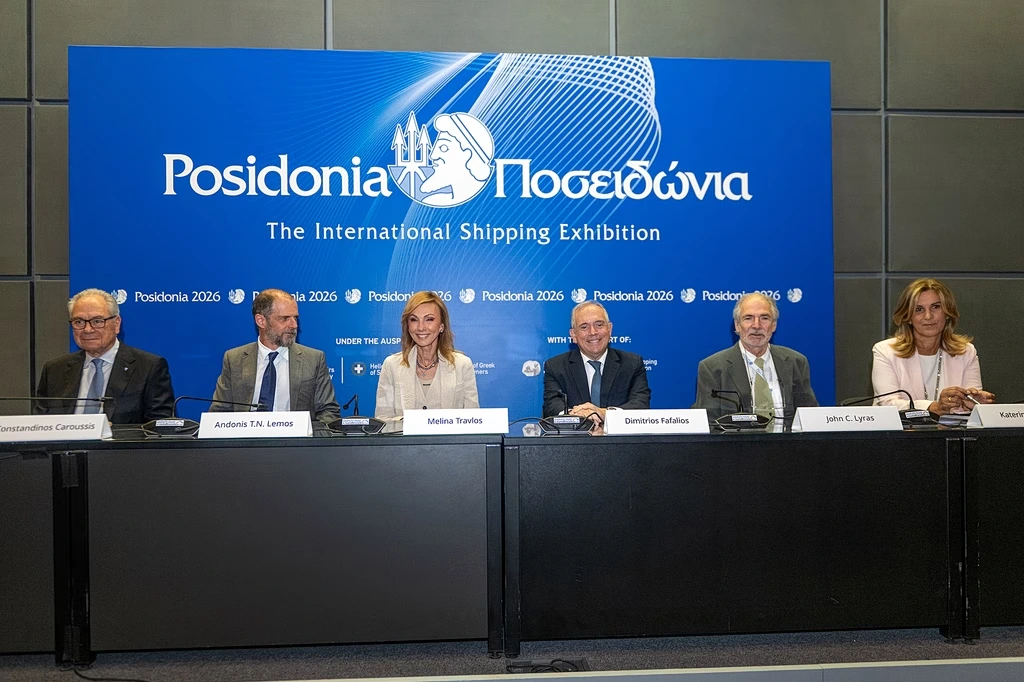
The Union of Greek Shipowners closed out Posidonia 2026 with its traditional press conference — and with a message that Greek shipping, despite mounting global pressures, remains as strong as ever.
Speaking to a packed room of Greek and international media, UGS President Melina Travlou covered the full range of issues facing the industry, from decarbonization policy and the shadow fleet to crew recruitment and education. Her tone was confident but candid.
“Freedom of navigation is of the utmost importance and must not become the subject of political or geopolitical disputes.”
Record orderbook, but competition is shifting
Travlou pointed to a 25-year-high orderbook of 931 vessels as proof of the industry’s commitment to the future. “Greek shipping is evolving, renewing itself, and remains just as strong as it has always been,” she said. Greece leads globally in new vessel investment, she noted, though it ranks second to China in overall fleet size — a distinction she was quick to qualify: roughly half of China’s fleet is state-owned.
Her broader concern was European competitiveness. She called on the EU to take concrete steps to strengthen the entire European fleet, not just the Greek one.
Decarbonization: ambitious targets, serious doubts
On the IMO Net Zero Framework, Travlou was direct. Shipping, she argued, was pushed into unrealistic targets shaped by EU political priorities that distorted the IMO’s original 2050 goals. She described the resulting mechanism as having strong revenue-collection characteristics, and questioned where the funds generated would ultimately go. The industry, she reminded journalists, accounts for just 1.6% of global emissions.
Greece abstained from the October 2025 vote on the framework — a position Travlou defended. She welcomed signs that the Greek government and a growing number of EU member states are now revisiting their stance in search of a more balanced and workable approach. Global measures, she stressed, are essential; regional ones alone will not do.
Shadow fleet and freedom of navigation
Pushing back on what she called the unfair targeting of Greek shipowners in shadow fleet discussions, Travlou argued with data that sanctions without global reach “inevitably distort competition.” On freedom of navigation — particularly in the context of ongoing threats in the Strait of Hormuz — she was unequivocal. The weaponization of vessels in conflict zones is an existential threat to the industry, she said, reiterating the position the UGS has taken at the UN Security Council.
A recruitment crisis in the making
Travlou was candid about the difficulty of attracting young Greeks to seafaring careers. “The current environment has not helped us,” she said, pointing to geopolitical tensions, attacks on commercial vessels, and active conflict zones as factors that make life at sea a hard sell for younger generations. She called for coordinated action across government, education, unions, and maritime organizations to change the narrative and dismantle outdated stereotypes.
365 scholarships — one for every day of the year
On a more optimistic note, she announced the largest scholarship program in UGS history: 365 university scholarships globally, across all academic disciplines — one for every day of the year. Raising the profile of shipping within Greek society, she said, had been a personal goal, and one she believes has been achieved.
Posidonia 2026 closed with a clear signal: Greek shipping is navigating a complex world, but it is not drifting.