

Co-Elevation

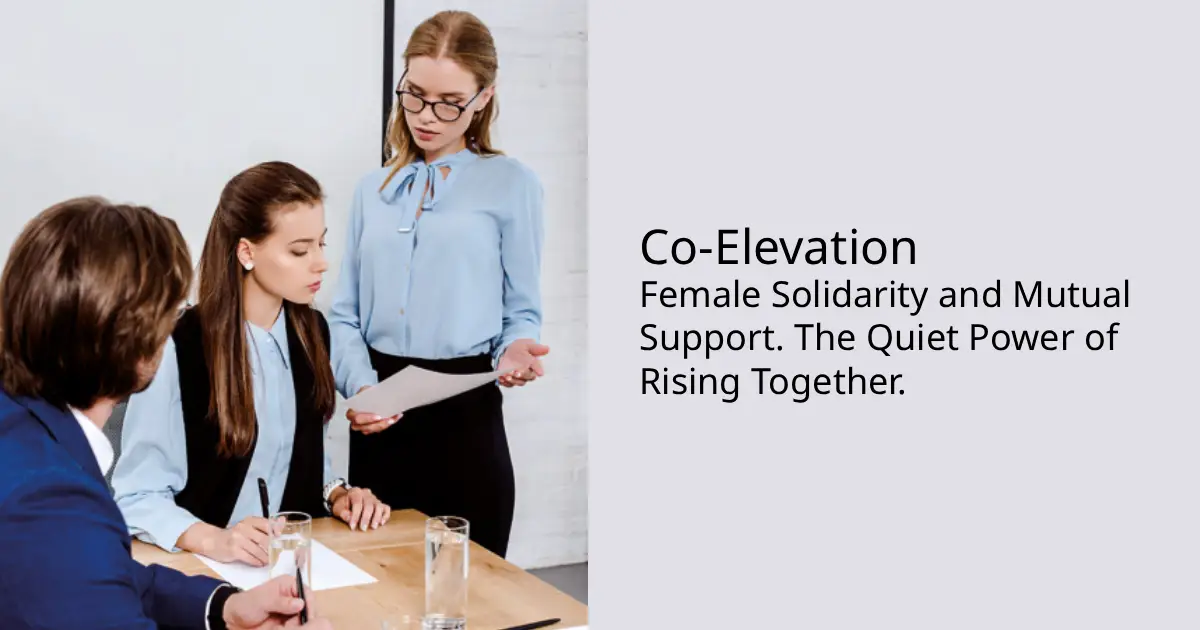
Female Solidarity and Mutual Support. The Quiet Power of Rising Together
Women’s solidarity is often taken for granted, yet in practice it is far from self-evident. Although women share common experiences, challenges, and expectations, their relationships are frequently shaped by comparison, competition, and subtle social pressures. When support gives way to silence or emotional distance,collective strength is weakened. In recent years, however, a more mature approach to women’s relationships has begun to emerge. Co-Elevation goes beyond solidarity; it speaks to shared evolution. It is not confined to “I’m here for you,” but consciously chooses “we rise together.” It is a model of connection that reflects the modern woman: ambitious, self-aware, and deeply human.
I have come to observe that the most meaningful relationships between women today are not built solely on support, but on something deeper: parallel growth. For a long time, women’s solidarity was framed as an act of kindness — “I’m here for you, I understand you.” Today, that narrative is evolving. A more demanding yet more authentic relational model is taking shape. In Co-Elevation, emotional presence alone is not enough; it is accompanied by awareness, reciprocity, and a shared commitment to growth. The relationship does not serve as a refuge from the world, but as a space for development. One woman’s success is not experienced as a threat, but as a promise — a quiet reminder of what is possible.
Psychological Resilience as a Collective Experience
Resilience is often celebrated as an individual achievement, the result of discipline and personal endurance. The most resilient people are those who belong to relationships marked by depth, honesty, and emotional safety. When women share not only their successes but also periods of transition, fear, and uncertainty, the pressure of perfection begins to loosen. Co-Elevation cultivates precisely this environment: a space where ambition coexists with vulnerability, and progress does not require isolation. Here, resilience is not hardness — it is connection.
Envy and Comparison: Hidden Information
Few emotions create as much discomfort in women’s relationships as envy. Often silenced or disguised, it is considered socially undesirable. Co-Elevation proposes a more mature reading: envy is not a moral failure, but information. A “well done” delivered more cautiously than expected, a message left unanswered, a success that unsettles us more than we would like to admit. When another woman activates us emotionally, she often illuminates something we desire but have not yet dared to pursue. Within a context of trust, comparison ceases to be a weapon and becomes a compass. Instead of distancing us, it points toward where we wish to grow. In this way, the emotion transforms from threat into inspiration.
The Shadow as a Bridge to Maturity
At the core of this process lies the concept of the Shadow — all that we have learned to suppress i.e. ambition, competitiveness, the need for recognition, and anger. For women in particular, these traits have long been deemed “unacceptable”. In Co-Elevation relationships, the Shadow is not rejected. It is observed and integrated. Points of friction between women are not treated as threats to the bond, but as opportunities for self-knowledge. When this work happens collectively, growth ceases to be a solitary path and becomes a shared experience.
The Elegance of Meaningful Bonds

Rising together requires a different quality of relationship: less performance, more presence; less validation, more truth. Co-Elevated bonds are defined by subtlety and depth — by the ability to speak honestly without wounding, and to listen without defending. In these relationships, success is not measured comparatively but is experienced collectively. The elegance here is not a matter of style, but of inner balance. It is a quiet certainty that there is space for everyone to flourish. Co-Elevation is not a trend. It is a way of being. A conscious choice to replace competition with collaboration, and comparison with shared growth. Perhaps the most radical form of women’s solidarity today is not simply standing beside one another, but rising together — without fear, without comparison, and with the awareness that there is room for all.
Sources of Inspiration
Aion: Researches into the Phenomenology of the Self — Carl Jung
In a Different Voice — Carol Gilligan
Self-Compassion: The Proven Power of Being Kind to Yourself — Kristin Neff
Dare to Lead — Brené Brown
The Art of Gathering — Priya Parker

Chryssanthi Sofrona-Kalogeropoulou,
Master Positive Psychology Coach
Mental Health Consultant
What's Your Reaction?