

Corfu: The precious jewel of the Ionian Sea

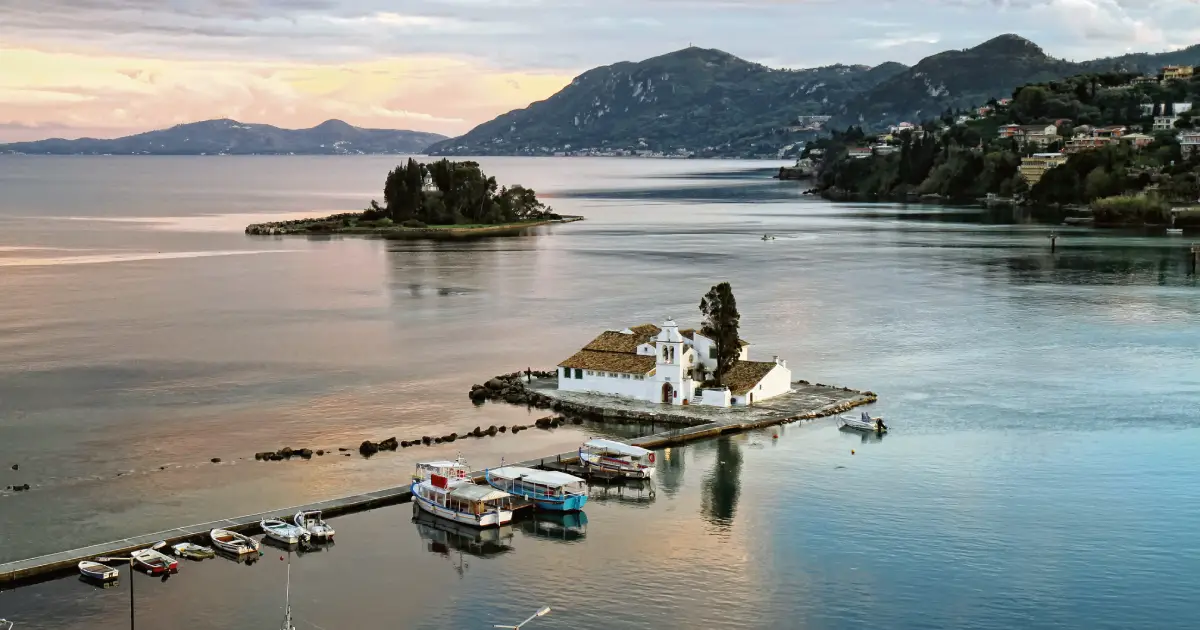
The jewel of Ionian Sea, with its ambient cantons, lush lace coastlines, and attractive mountain villages, the alluring “island of the Phaeacians” knows how to respect centuries-old secrets as well as the poetry of a life that defies passing trends.
Article and Photographs: Ioanna Paravalou
We thank the photographer Stamatis Katapodis / KATAPODIS Photography-Corfu
With a desire to get to know more about the undiscovered charm of the well-known Ionian Island, we will journey together to discover its distinct culture, high level of culture, traditions, magnificent mountain villages, alluring beaches, idyllic sunsets, but also its distinctive regional cuisine!

It has been the target of numerous invaders throughout history because it is the northernmost island in the Ionian Sea and is seen as a crossroads between East and West. The Venetians, French, Russians, and English all captured Corfu, which was formerly a part of the Byzantine Empire.
She was able to develop a unique cultural identity thanks to the influences she encountered. Both the exterior design and the interior décor of public buildings, mansions, and ordinary urban homes exhibit signs of the West’s influence.
The Old Town: An Unesco World Heritage Site
Surrounded by walls and fortresses, with Venetian multi-story houses separated by narrow cantons, with lanterns and shields, it is a place worth visiting any time of the day. Here is the Campiello, the old Jewish neighborhood.

The Old Town is the largest “live” medieval city that has been preserved in Greece, masterfully combining its diverse architectural aspects to show how the various cultures influenced it.

The Old Town and the New Town of Corfu are not separate. Therefore, there are comfortable streets and spacious squares next to the cantons, among which Spianada stands out, rightfully considered the most beautiful square in Greece and the largest in the Balkans. Cricket lovers will find here an amazing venue for their favorite game, which has been a tradition in Corfu since the days of the British administration. On its western side, is the famous Liston.
Walk in Liston
Liston has a beautiful walkway with cafes and arched terraces. It was built in 1807 by a Frenchman named Mathieu de Lesseps and serves as an example of the architectural style that was prevalent when the French occupied Corfu during the Napoleonic era.

Bounded by the Old or Sea Fort and divided from the city by the Contra Fossa, a moat with a drawbridge.
Korifo, the Byzantine city of Corfu, was originally located within. Here we shall come upon the church of Agios Georgios.

We shall ascend to the Fortress’s peak and the view from up here is breathtaking! The New or Stergian Fortress was built between 1576 – 1588, to protect the city from a possible Turkish invasion.
Libro d’ Oro: The nobility of Corfu
Corfu society was divided among nobility, bourgeois, and commoners throughout the Venetian period. The lowest layer, the “plebaya,” was made up of bio-wrestlers. It was decided in 1572 to construct the Libro d’ Oro containing the names of the noble families. Each noble candidate had to demonstrate that he met the three qualifications of ancestry. That is, himself, his father, and his grandfather, unless they were goldsmiths, apothecaries, or art dealers, did not engage in “brutal work” or manual labor.
Kanoni
One of the island’s popular tourist spots is Kanoni, which is close to the airport and has a view of Pontikonissi. The 17th-century Monastery of Panagia Vlacherna is accessible only by a small stretch of land.
From the shoreline, one can go to Pontikonissi and see the picturesque Pantokrator chapel.

On the road to Kanoni, we will stop at the Paleopolis Museum (Mon Repos) to see the stunning gardens, the imposing mansion (formerly the summer residence of the former Greek royal family), and the archaeological treasures.
Gastari (10 km from Corfu) managed to charm Empress of Austria Elisabeth (Sissi) to build the grandiose “Achillion Palace” in 1884-1891, to be used as a resting place. It is now a museum.

During both World Wars, the palace suffered damage and looting, but today, fully restored, it has regained its former grandeur and continues to captivate visitors. We will walk through its beautiful gardens and see the two magnificent statues, Achilles of Death and Achilles of Victory. Inside the palace is the huge oil painting “The Triumph of Achilles.”
It is worthwhile to take a stroll to Benitses, an old fishing village, that is now a popular tourist destination with beautiful taverns by the sea.
The island of literature and arts
The Byzantine Museum, the Archaeological Museum, the Museum of Asian Art, the Old Palace (an imposing building from the early nineteenth century), the San Giacomo Town Hall, the Church of Saints Jason and Sosipatros, the Church of Agios Spyridon, the Metropolis, Agios Nikolaos of the Elders, and the Monastery of Panagia Platytera are all worth seeing in Corfu.
Dionysios Solomos Museum
The house in Corfu where our nation’s poet Dionysios Solomos spent most of his life and his most creative years (from 1828 to 1857). www.eksmouseiosolomou.gr

Catholic Cathedral (Duomo)
A church dedicated to Saints Iakovos and Christopher. Since 1632, it has been a Catholic cathedral. M. Theotokos Square (Old City Hall).

Holy Church of Saint Spyridon
The church of Saint Spyridon, which serves as the island’s spiritual hub, is among the most significant post-Byzantine structures in the city. It was constructed around 1589.


The Voulgaris family owned the Saint’s tent and were the church’s founders. The bell tower is like the one at Venice’s Saint George of the Greeks church (San Giorgio dei Greci). There are valuable artifacts and “tamata” in the temple. A lavish silver urn from the 19th century houses the relic of Saint Spyridon the Wonderworker.
Jewish Synagogue
The first presence of Jews in Corfu is mentioned in the 12th century. and, by the time of the German occupation, the community numbered nearly two thousand people.

Corfu Reading Society
One of the oldest cultural institutions in the country. It was founded in 1836 by young scientists who were inspired by the Geneva Reading Society. Several other notable individuals from politics, the arts, and literature were also members, along with the poets D. Solomos, A. Kalvos, I. Polylas, and L. Mavilis. The library is of great value and predominantly of Heptanisian interest. (anagnostikicorfu.com)

Asian Art Museum
Dedicated to the art of Central Asia, the Far East, and India. It includes 15,000 ceramics, porcelains, sculptures, ivories, and coins. (matk.gr)

Palace of Archangel Michael & Saint George
To the north of Spianada, it is perhaps the most important monument of the British period. It was built in the period 1819-1823 by the English Commissioner Sir Thomas Maitland and was used, among other things, as the residence of the English Commissioners, as the seat of the Ionian Senate, and as the seat of the Order of Archangel Michael & Saint George. On its eastern side is the so-called “Garden of the People”, a place for walking and recreation. The palace today houses the Asian Art Museum and the Corfu Municipality Art Gallery.

Gallery of the Municipality of Central Corfu – Permanent Collection
With its variety of visuals and current exhibitions, it is a focal point of art and culture. Here you may see works by great Heptanesean artists that were influential in the evolution of Greek art from the 17th to the 20th century. (artcorfu.com)

Archaeological Museum
Here you will see many remarkable works from the Archaic period to Late Antiquity.

Church of the Holy Apostles Jason and Sosipatrou
The most important monument of the Byzantine period in Corfu. The church is dedicated to the disciples of the Apostle Paul, who preached Christianity in Corfu. It was built around 1000 AD, in Paleopolis. Inside the church are the tombs of the two Apostles as well as pieces of their holy relics.

The National Gallery
and Alexandros Soutzos Museum
Starting with the work “The Crucifixion”, attributed to Domenikos Theotokopoulos,
the journey in art goes through the Heptanesean School, the Munich School, Greek Modernism, the Generation of the 30s, Abstraction, the experimentation of the 70s, the return to the painting of the last two decades of the 20th century (nationalgallery.gr)

Kapodistrias Museum
The only museum that is solely dedicated to the memory of the first Greek Governor is the Kapodistria Museum-Centre of Kapodistrian Studies, which is situated seven kilometers outside of Corfu. Along with personal items of Ioannis Kapodistrias and vintage furniture, it is housed in one of the old rural homes of the Kapodistria family that Maria Kapodistria-Desyllas donated in 1979.

“Nikolaos Halikiopoulos Mantzaros” Music Museum
It was inaugurated in 2010, exactly 170 years after the Philharmonic was founded.
Instruments, pictures, student books, photographic material, sheet music, audio documents, and the visual works of artists can all be found here. (fek.gr)

Banknote Museum
The first Bank in Greece, Ioniki, operated here. Since 1981, the museum houses a remarkable collection of rare banknotes, including a Chinese banknote (silk-printed around 1300), one of the oldest surviving in the world.

Platyteras Monastery
Chrysanthos Syropoulos, a hieromonk from Lefkada, founded it in 1743. The Kapodistria family, whose tombs are here, had unique ties with the Monastery.
The Monastery houses works of religious art of significant aesthetic worth.

Discovering the beauties of the north…
If we go north in our car, we will see Alykes, a coastal community with vacation homes, and Gouvia (old Venetian Naval Station, today a tourist center).

A few kilometers further down, Dassia, which has some of the best hotel complexes, emerges through the greenery. The charming fishing village of Ypsos, which has a great beach and lively nightlife, is close by. As we go along the coastal road, we pass by communities that are completely covered in greenery and have stunning beaches, including Barbati and Nisaki, with wonderfully colored waters.

Everywhere you will find tavernas, next to the sea, with local snacks, fresh fish, and good wine. Kalami is one of the most picturesque ports on the island, with a nice beach and blue-green waters.
The road to the north is especially lovely because on the slopes of Pantokrator (the highest mountain of Corfu) diverse landscapes can be seen at every turn of the drive. We will soon be in Kassiopi, a quaint fishing village with a lovely port and a majestic castle. Here we will swim in crystal clear, turquoise waters.
From Kassiopi, Roda and Sidari you can take daily boat trips to the Diapontia Islands, Othonous, Ereikousa and Mathraki. Here one can enjoy the beauty of nature, without the tourist crowds.
In Peroulades and the Canal d’ Amour…
Exotic colors, strange rock formations, waters with tropical colors and idyllic coves make up the landscape after Sidari. The area is known as the Canal d’Amour.

A beach with white sand and emerald waters forms in each cove. Dreamy landscape!
Heading west…
The western coast faces the Adriatic and literally enchants us. About 26 km from Corfu is Paleokastritsa, which, according to many scholars, is considered the Homeric city of the Phaeacians.

The view from above, as we descend, is unique and the waters blue-green and crystal clear. To the right, on top of the hill, is the historic monastery of Paleokastritsa, dedicated to the Virgin Mary.
After the village of Krini is Angelokastro, a fortress built on a steep peak and overlooking the endless blue…

On the northwest coast of Corfu, close to Paleokastritsa, the Byzantine fortress is built at an altitude of 300 meters. It served as the westernmost outpost of both the Despotate of Epirus, to which Corfu also belonged until 1267, and the Byzantine Empire. It was constructed at the start of the 12th century. The Taxiarches and St. Kyriaki churches are still standing inside.

The most beautiful view of the area may be enjoyed from the village of Lakones and the position “Bella Vista”.
There in the South…
From the city of Corfu, continuing south, we will reach Agios Ioannis Peristeron, Moraitika and Messogi, where the largest olive grove of the island is located. A fork in the road leads to the important Coryssion Lake. The beach of Agios Gordis near Lefkimmi, is an ideal all-day stop to enjoy the sea and an idyllic sunset.
Whatever part of Corfu you visit, this island will enchant you, whether you want the richness and comfort of modern tourist facilities or the beauty of tradition and picturesqueness. Experience it with all your senses!
Activities
Α natural oasis in the middle of Corfu, Corfu Golf Club is an ecosystem in itself that can be conveniently accessed from different parts of the island. Corfu Golf Club: Ermones, Ropa Valley (E-mail: info@corfugolfclub.com, T. +30 26610 94220)


Ride on Issos in Lefkimi to discover the beauty of Corfu. “Corfu Riding Center Dimitris ISSOS”, tel. 6977399481 and 6947228489, (Mr. Dimitris Katsaros).

What will you eat
Pastitsada (veal or rooster in a pot with fresh tomato and thick spaghetti), sofrito (beef in a pot with white sauce and mash or fried potatoes), burdeto (scorpion fish or cod, with red sauce in the pot), cigarelli (fried wild herbs with garlic and red pepper), numbulo (excellent smoked pork sausage), bianco (fish stewed with lemon, garlic and pepper), savoro (fried fish with rosemary sauce, vinegar, garlic, and raisin.


Kum-quat
A tourist emblem of the island, the fruit of the citrus japonica tree was brought to the island by the English. It is used to make liqueur and small sweets.