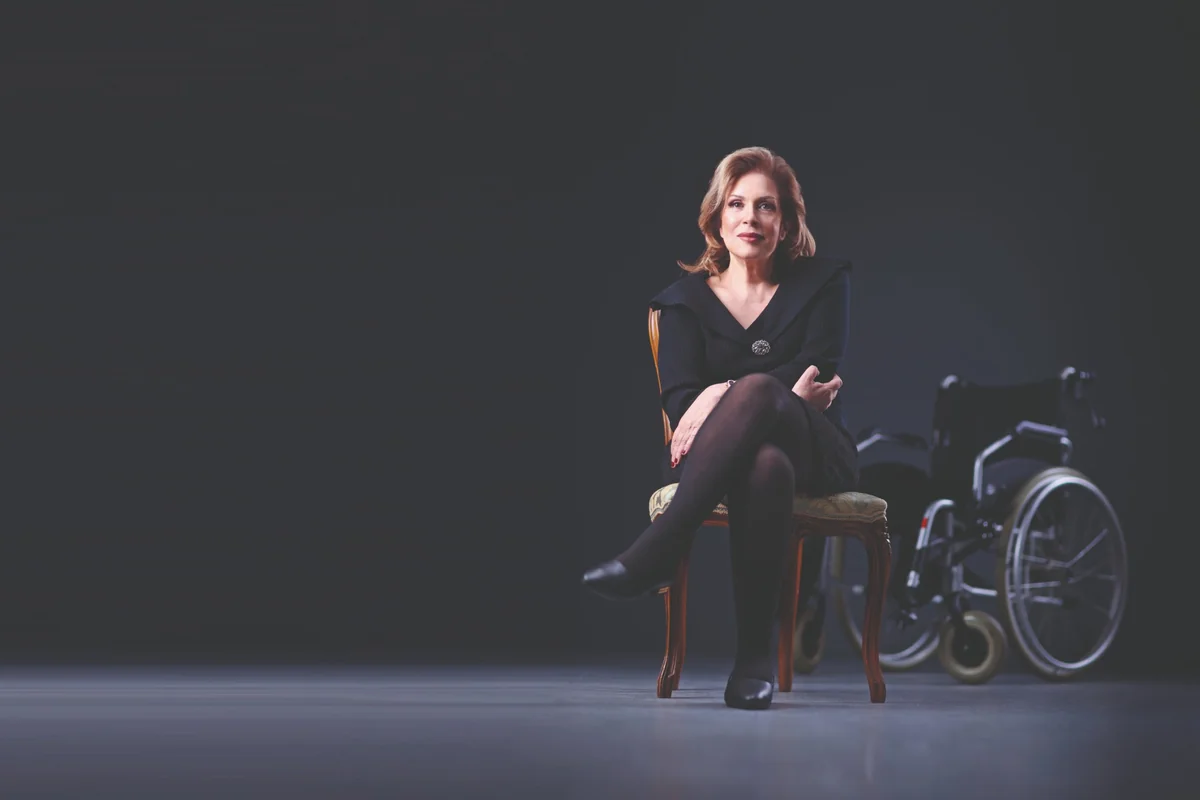
An accomplished lawyer, Phaedra Tsalachouri knows what it means to fight every day to earn her place on the front line. She has done so in courtrooms, where she has passionately defended her clients, and now in politics, as she seeks election to Parliament as a «New Democracy» candidate in Athens’ First Electoral District. Her disability and the use of a wheelchair have never led her to limit her dreams, choices or ambitions. On the contrary, her everyday experiences have given her a distinctive perspective on accessibility, equality, social participation and the need to build a society that leaves no one behind. Direct and forthright, Phaedra Tsalachouri speaks to VOLTA about the life of a woman who has learned to face challenges with determination. As she embraces a new challenge in politics, she remains firmly convinced that obstacles should never define the limits of a person’s journey.
You have said that your profession requires brains, not legs. Should a determined person with a disability have to justify themselves when seeking positions of responsibility?
Yes. The legal profession requires intellect, constant mental alertness, diligence, readiness and expertise. For tasks that involve rushing between offices or waiting in queues, you need one or more assistants. We are often forced to justify ourselves. Perhaps this is because many people cannot accept that someone who cannot walk may perform better than those who have no health issues at all.
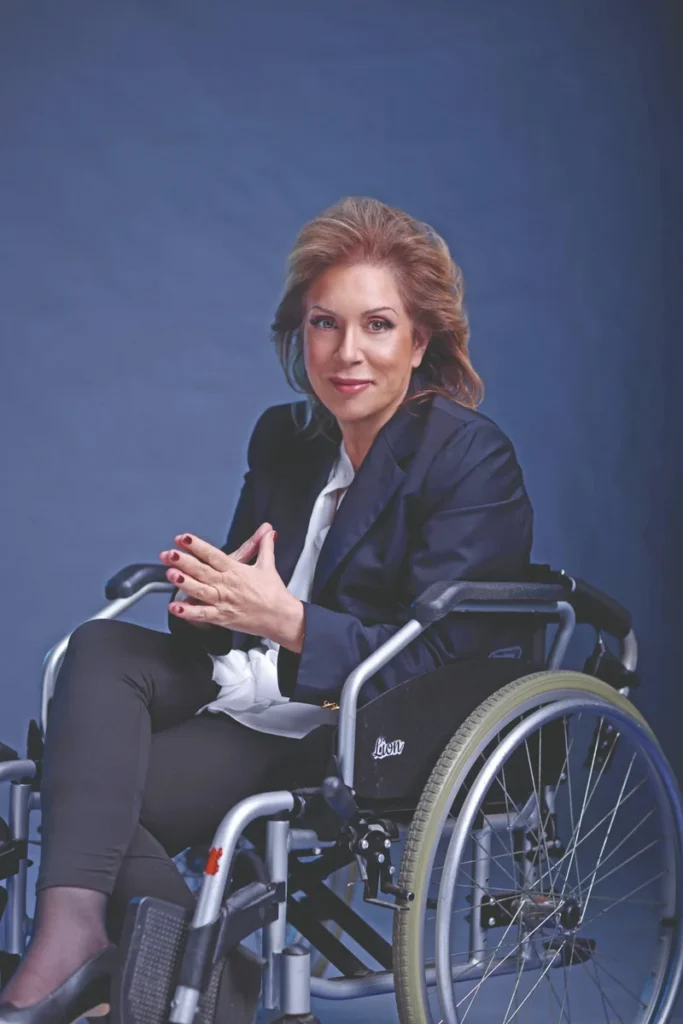
How easy is everyday life for a practicing lawyer with a disability?
Believe me, it is by no means easy! Getting ready and leaving the house in the morning takes almost three times as long as it would for most people. You must plan every step of your day: where you will park, how you will manage if a place is inaccessible, and even how you will go out for dinner or enjoy a theatre performance.
Who has served as a role model or influenced you, either professionally or personally?
The person who has inspired me through his example is our Prime Minister, Kyriakos Mitsotakis. I have identified with his advice: “There is no such thing as ‘I can’t’; there is only ‘I don’t want to.” “Wake up early and have a plan.” “When you promise something, never go back on your word. Make sure you deliver; otherwise, do not make the promise.” “Always work with the public good in mind.” And “Always be courteous and civilised, and remain committed to your work, no matter how much others may try to discredit, accuse or ridicule you.”
What have been the defining moments of your career?
I will always remember the moments I experienced in criminal trials, when I felt my heart stop just before the verdict was delivered. You fight so hard for your client that, eventually, you become deeply invested in their fate. Some trials have been triumphs; others, very few, have felt like a punch to the stomach. Above all, however, justice must prevail.
As a lawyer specialising in financial crime, which case affected you most deeply, and what did it teach you about the Greek state and its citizens?
One major financial crime case that truly shook me was the Energa-Hellas Power case. As you may recall, in 2017 the company’s chief executive was sentenced to 21 years in prison by the Three-Member Court of Appeal for Felonies for embezzling public funds. It was a sound ruling, based on a thoroughly substantiated complaint and the prosecutor’s recommendation. On 1 July 2019, just six days before the national elections, the SYRIZA government amended the Criminal Code, reclassifying the embezzlement of public funds as a misdemeanour. This enabled the convicted executive to be released immediately, after which his sentence was reduced to five years, suspended for three years. In my view, this amounted to a blatant interference by the executive branch in the administration of justice, which is unacceptable.
What qualities should someone seeking elected office possess?
They should certainly have a sound understanding of the law, enabling them to navigate parliamentary proceedings effectively. Even if they are not legally trained, they should have studied the relevant framework. More importantly, they must genuinely care about the common good and work tirelessly, from morning until night, to advance the country, whatever their field of responsibility—national defence, foreign policy, the economy, healthcare or education. They must have empathy and a sincere determination to help move Greece forward, contributing their own part to that effort.
“Put roller skates and a pair of ball bearings in your heart.”
Athens’ First Electoral District stretches from Kolonaki to Kolonos and from Pagrati to Patissia, encompassing significant socioeconomic differences. How would you bridge the needs of such diverse communities?
Athens’ First Electoral District is the old heart of Athens. Its boundaries coincide with those of the Municipality of Athens. There are indeed socioeconomic differences. Metaxourgeio is different from Kolonaki, just as Pagrati is different from Petralona. Yet we all share something wonderful: we are Athenians. We are constantly on the move through the capital’s streets, every day, all day long! And we are all striving for a better life in a city with many longstanding problems, but also so much beauty.
Drawing on your experience and political perspective, how do you view the challenges facing Greek businesses and self-employed professionals?
Businesses and self-employed professionals have suffered for decades from an unbearable tax burden, excessive social security contributions, chaotic bureaucracy and difficulties in repaying their debts. We are now moving in the right direction, particularly through the digitalisation of administrative procedures. Self-employed professionals need even greater support because, unlike salaried employees, they do not receive a fixed monthly income. They work around the clock, taking risks and carrying the responsibility themselves. The «New Democracy» government has taken, and continues to take, steps to strengthen entrepreneurship.
As a member of «New Democracy’s» Secretariat for Persons with Disabilities, which policies do you consider most successful, and where is further progress needed?
I would begin with the establishment of the Personal Assistant programme, which has now become a permanent, nationwide initiative. This is revolutionary! People with disabilities can receive assistance that enables them to leave their homes, work, socialise, travel and participate in political life on equal terms. The Personal Assistant programme therefore helps dismantle the social exclusion that people with disabilities have endured for decades. Too often, they were left to wither behind the four walls of their homes, confined to the back rooms. Second, we are moving towards deinstitutionalisation by creating supported living homes for small groups of people with similar health needs, with a dedicated person available to supervise and assist them. Third, we are increasing the disposable income of people with disabilities. These are just some of the measures being implemented, all with the aim of providing meaningful and effective support.
When do you believe a person truly contributes to society?
I believe everyone begins by striving for personal growth and success. True contribution, however, begins when that effort goes beyond individual gain and creates opportunities for others as well. When you look around and see that many people in society are benefiting from something you have worked hard to achieve, then yes, you have made a genuine contribution to society!
What issues in our society concern you most, and what would you most like to see changed?
I care deeply about the future of young people, the family and people with disabilities. I cannot tolerate indifference, cruelty, violence, intolerance, the constant cultivation of negativity, mockery and, above all, ingratitude. It is time for us to become a more humane society, and that depends on every one of us.
How would you convince an undecided voter in Athens to place their trust in you?
I would not try to convince anyone with grand promises. What matters to me is that people get to know me, that we talk, perhaps over a coffee, and that they can see for themselves that I mean what I say. I make myself available to people, listen to their needs and concerns, and work to achieve changes that can improve their lives. I am accessible and present in practical terms, not just in words. I firmly believe in authenticity, personal contact and the power of optimism. I have always been genuine, I remain so today, and I intend to stay that way. Ultimately, this is the relationship of trust I seek to build with citizens: one that is personal, direct and meaningful. And I say this as a woman who firmly believes, and whose life stands as a testament to the fact, that obstacles should never define the limits of a person’s journey.
What is your motto in life?
My motto comes from a line in a song that, at some point in our lives, we have all found ourselves singing under our breath, with our fists clenched:
We wish you every success!